 CHAPERONE AI
Want this table with your classes in it?
Cones took one adaptation run. Your defect taxonomy, parts, or PPE classes follow the same recipe, and you get the eval report with the weights.
Book a technical callmAP on the original 80 classes after adaptation, from a 51.2 baseline
The added class outscores every one of the 80 original classes
1.2 points of COCO traded for the best-scoring class in the model
Average forward plus NMS per frame, measured on an A100
One evaluation protocol across the family, all four sizes measured. The s checkpoint finishes above the baseline it started from; l and x give up about 1.2 points of COCO to make room for the new class.
| Checkpoint | mAP 50-95 (81 cls) | COCO kept (80 cls) | vs YOLOX base | AP50 | AP75 | Cone AP | Cone AR | Inference |
|---|---|---|---|---|---|---|---|---|
| yolox-pylon-s | 42.0 | 41.6 | +1.1base 40.5 | 60.2 | 45.8 | 74.5 | 77.7 | 1.7 ms |
| yolox-pylon-m | 47.2 | 46.8 | -0.1base 46.9 | 64.9 | 51.3 | 77.5 | 80.4 | 2.6 ms |
| yolox-pylon-l | 48.9 | 48.5 | -1.2base 49.7 | 66.0 | 52.7 | 78.6 | 81.4 | 3.7 ms |
| yolox-pylon-xl | 50.4 | 50.0 | -1.2base 51.2 | 67.3 | 54.4 | 78.8 | — | 6.0 ms |
COCO val2017 at 640 input. mAP is IoU 0.50 to 0.95. The 80-class figure removes the cone class from the average to isolate retention, and the delta compares it to the official YOLOX val2017 baseline for the same size. Inference is average forward plus NMS per frame, measured on an A100. Per-class recall was not logged in the x-large run, so its cone AR is left blank rather than estimated.
Two frames per model, at the same confidence threshold. On the left the added class in a road scene. On the right an untouched COCO val2017 image, because the point of the whole exercise is that the second one still works.
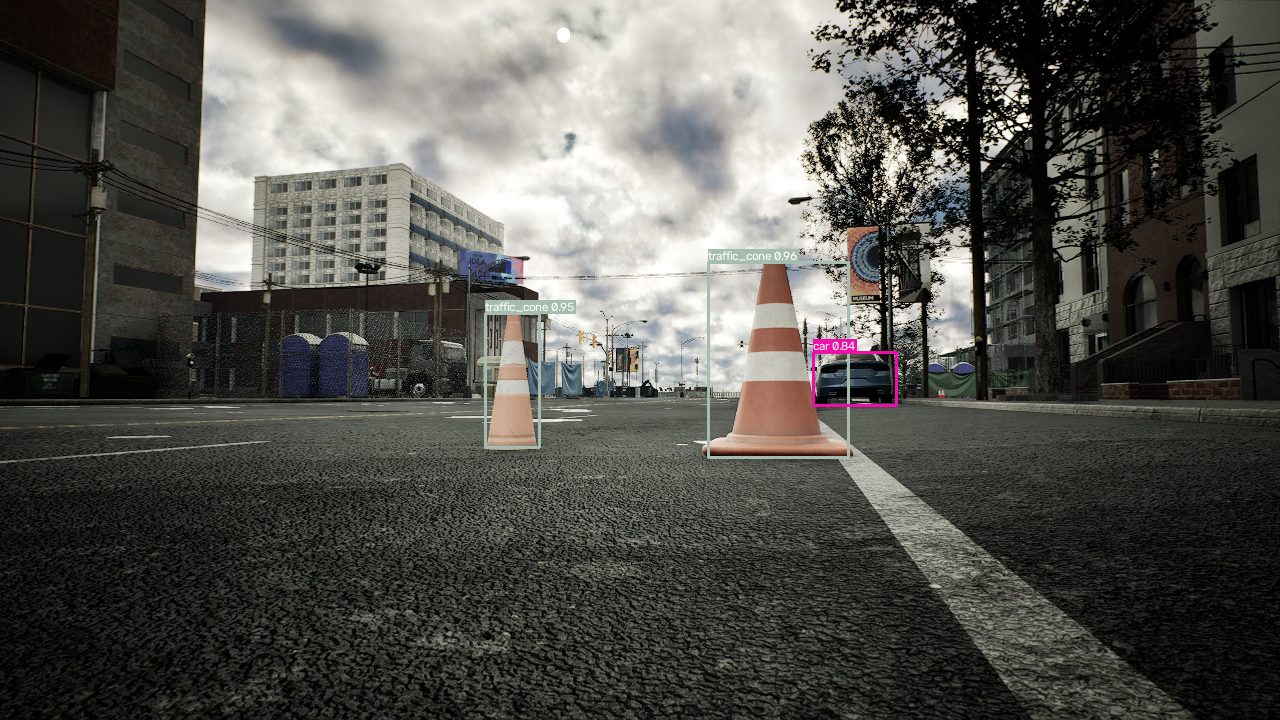
Two cones at 0.95 and 0.96 in a wet-road scene, with car still picked up at 0.84 down the street.
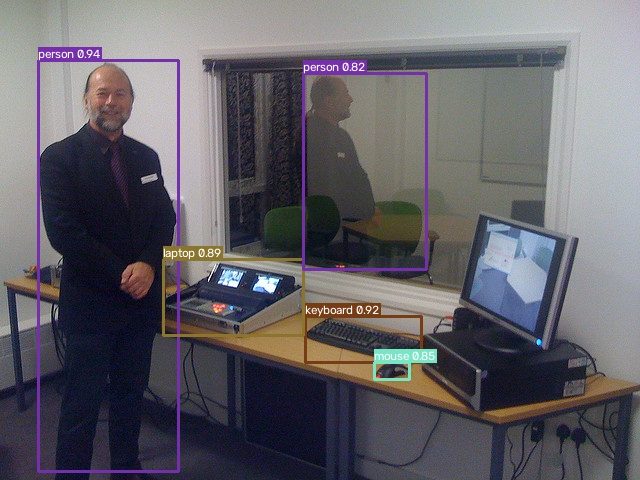
The originals, untouched: person 0.94 and 0.82, laptop 0.89, keyboard 0.92, mouse 0.85.
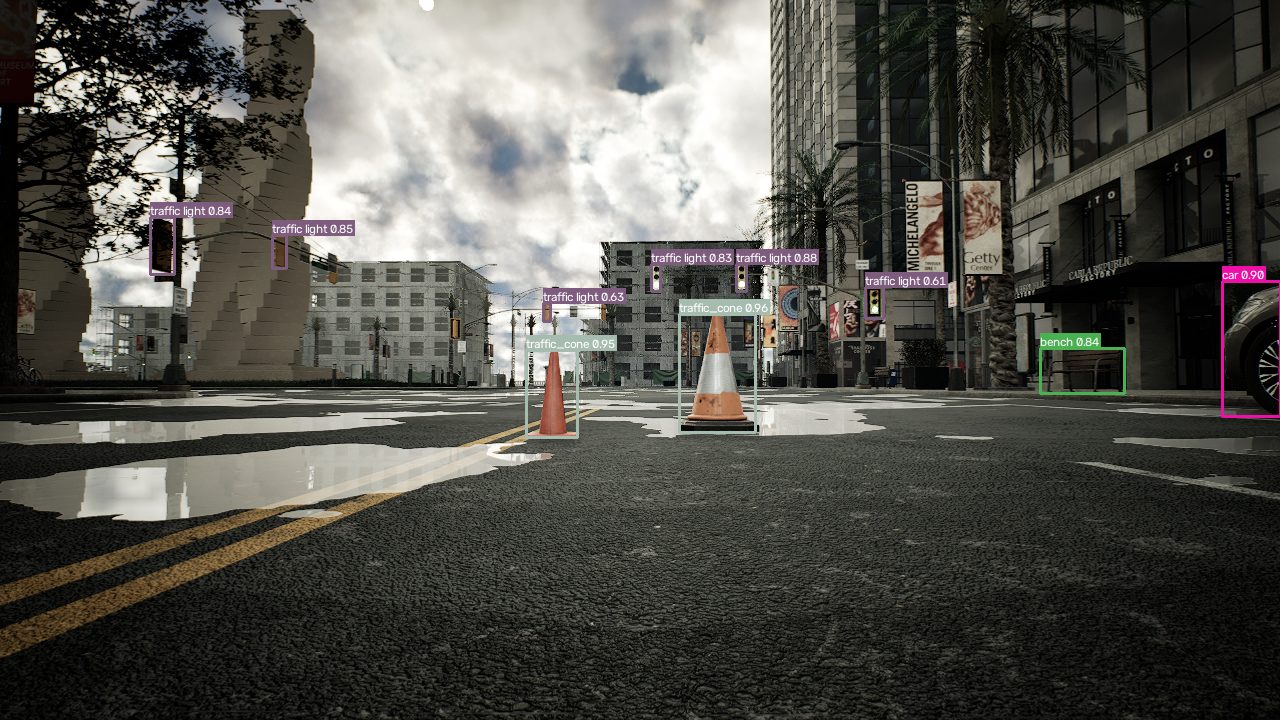
Cones at 0.95 and 0.96 while six traffic light boxes, a bench and a car hold at the same time.
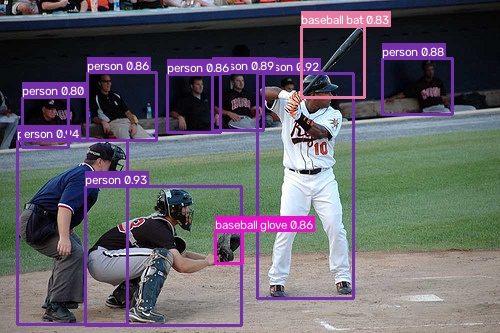
A crowded val2017 frame: seven person boxes plus baseball bat 0.83 and baseball glove 0.86.
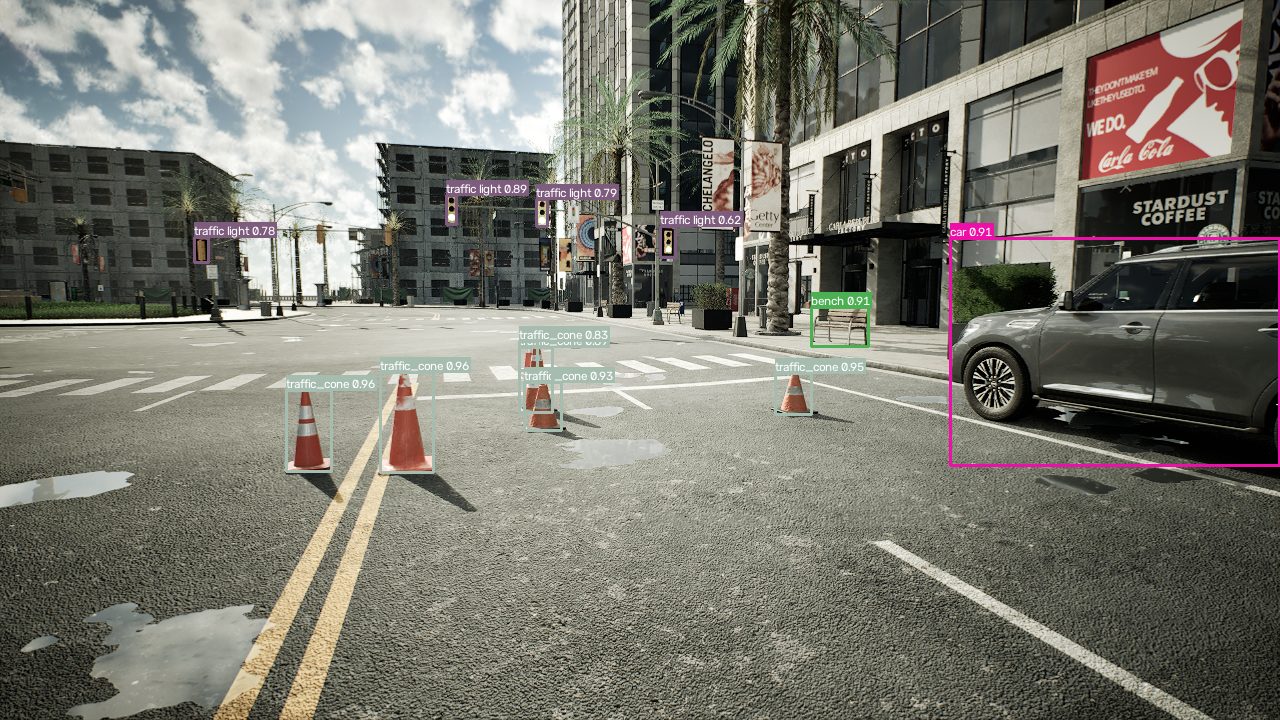
Five cones from 0.83 to 0.96 across the full depth of the scene, alongside car 0.91 and bench 0.91.
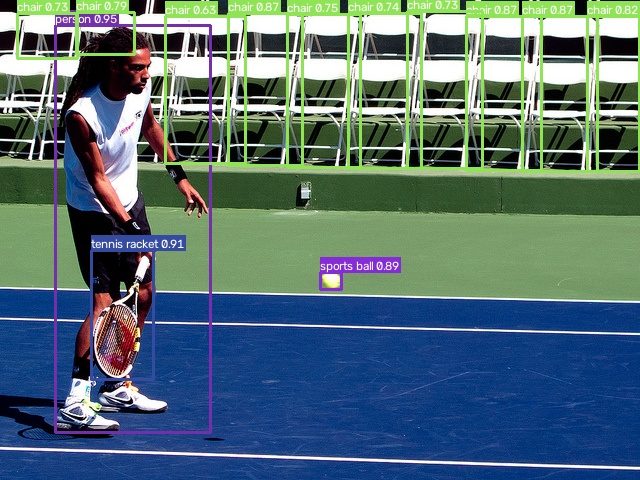
Small and cluttered: tennis racket 0.91, sports ball 0.89, and nine chair boxes behind the player.
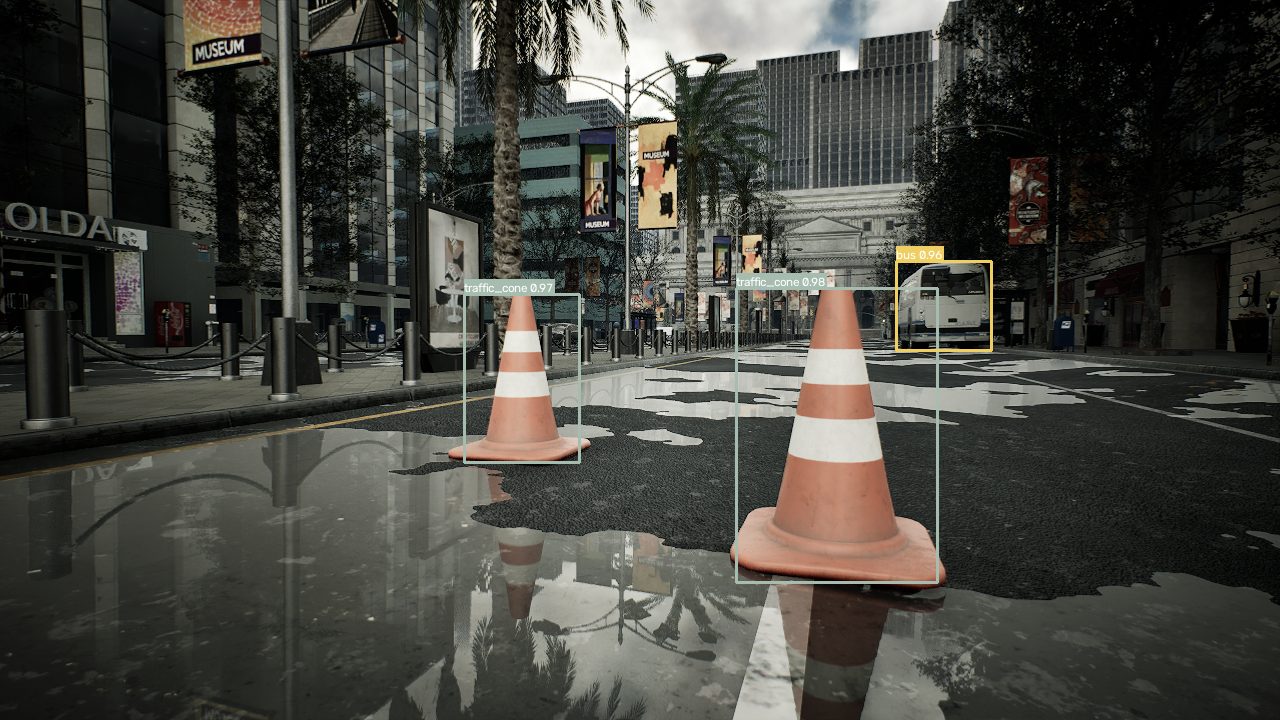
The most confident cones in the family, 0.97 and 0.98, with a distant bus at 0.96 through the reflections.

Dense indoor clutter: tv 0.90, two keyboard boxes, laptop 0.95, mouse 0.94, bottle 0.65 and stacked book boxes.
A new class is only worth adding if it arrives at full strength. On the x-large checkpoint, traffic cones are the single best-scoring class in the model, ahead of all 80 that YOLOX was originally trained on.
Per-class AP at IoU 0.50 to 0.95, yolox-pylon-xl on COCO val2017 plus the cone split. The highest and lowest scoring classes are shown for scale. The cone class is top of the list on s, m and x; only on l does another class edge it, bear at 79.7 against 78.6.
The only comparison that answers the question is the one against the model we started from. Same architecture, same parameters, same FLOPs, one extra class. So the single number that moves is the COCO score on the original 80 classes, and this is what it did.
Baselines are the official YOLOX val2017 figures. Our value removes the cone class from the average, so both ends of each line describe the same 80 classes. At s the adaptation finishes above the base it started from, which we put down to the longer training schedule. At m the difference is inside the noise. At l and x it costs 1.2 points.
Nothing else about the model moves. Parameters, FLOPs and inference cost are identical to stock YOLOX at every size, because the only architectural change is one extra class in the head, and Apache 2.0 carries over from the base.
| Size | YOLOX base | yolox-pylon, COCO kept | Change | Cone AP added |
|---|---|---|---|---|
| yolox-pylon-s | 40.5 | 41.6 | +1.1 | 74.5 |
| yolox-pylon-m | 46.9 | 46.8 | -0.1 | 77.5 |
| yolox-pylon-l | 49.7 | 48.5 | -1.2 | 78.6 |
| yolox-pylon-xl | 51.2 | 50.0 | -1.2 | 78.8 |
Cones took one adaptation run. Your defect taxonomy, parts, or PPE classes follow the same recipe, and you get the eval report with the weights.
Book a technical call
We use cookies
Some cookies are needed for this site to work. We would also like to set analytics cookies to understand how the site is used — but only if you agree. Privacy policy
Strictly necessary
Session and security cookies that keep forms and logins working. These cannot be switched off.
Analytics
Google Analytics, to count visits and see which pages are read. Off unless you turn it on.